Far into the frigid Southern Ocean, the Ady Gil strikes a Japanese whaling boat, the Shonan Maru No. 2, shooting butyric acid and shining lasers into the sailors’ eyes. The Sea Shepherd Conservation Society members ready their firearms and unleash thick ropes to entangle the Japanese’ turbines. Unthreatened, the Shonan Maru No. 2 smashes the Ady Gil, destroying the multi-million dollar American vessel and triumphing once again in the whaling war. Conflicts like these between pro-whaling countries and conservationist groups are rising due to increasing whaling sustainability concerns. Though commercial whaling is now illegal, countries like Japan and Norway avoid the moratorium and continue their practices as desired. To fix this issue and prevent further violence, United States environmental scientists have proposed a whale market trading system,1, which would allow countries and individuals to purchase limited whaling licenses. However, a whale market quota-trading scheme would not resolve conflicts between whale conservationist groups and pro-whaling countries nor assist whale conservation. I believe this scheme would fail to solve the current whaling system’s environmental, economic, and moral issues, leading to further conflicts over an organism that the marine ecosystem cannot afford to lose.
The whale market quota-trading scheme idea entails an international body, the
International Whaling Commission, issuing a certain number of permits that
would allow a certain number of whales to be killed. Individuals and countries
around the world would then be able to sell or purchase permits from each
other. Whale conservation groups or anti-whaling countries could
potentially purchase them too, but the permits would go unused. The idea is
controversial, but it is clear to me that the scheme will fail.
 |
| A whale harpoon gun http://flic.kr/p/9hxA5B |
A new market scheme would also fail to make whaling more sustainable because if
all the quotas were fulfilled, the number of whales killed would be the same as the number killed today by the Japanese,
who currently avoid the moratorium by claiming whales for “scientific
research.” Thus, the potential exists that the quota-trading scheme wouldn’t
improve environmental conditions.
 |
| http://flic.kr/p/5YvPY3 |
The whale market quota-trading scheme is an attempt to solve whaling controversy economically,
involving markets across the globe to purchase and trade quotas in a fair
financial system. Researchers and economists hope that anti-whaling organizations will purchase quotas
to directly prevent whale killings. However, it’s highly unlikely that conservationist bodies could
scrounge up enough funds each year to purchase many whales.
Anti-whaling groups have already heavily invested in other forms of
anti-whaling campaigns and may want to use their funds towards ending whaling
altogether, not towards a system that can encourage whale killing.
Reporter Christopher Mims of Grist outlines another
economic challenge for the quota-market trading scheme. He asserts that the
eighty-nine countries in the IWC are unlikely to agree on a global market plan,
making the scheme extremely difficult to implement and administrate. The
greatest logistical difficulty would be determining the distribution of quotas
to the countries fairly; balancing whaling country needs, anti-whaling
country desires, and indifferent member country rights would surely lead to heated debate at the annual
convention of the International Whaling Commission.
The comparison to current "cap-and-trade" air pollution systems is the most prominent evidence economists provide to make the case for the market scheme. In the
United States, the Environmental Protection Agency issues an overall cap on
pollutant emissions, and companies can trade their individual allowances,
rewarding industries that pollute less. Though the systems have many
similarities, the success of the current cap-and-trade system cannot be translated for whale market quota-trading.
For example, sulfur oxides are controlled by cap-and-trade, but they are
emitted as the result of an activity that most people agree is necessary,
electricity production. Few people argue that electricity production is immoral
and should be halted, unlike whaling. Cap-and-trade systems also require intense regulation and monitoring to be successful, a difficult
task for the IWC. Whale market quota-trading would be a poor version of a
cap-and-trade system that would not be economically viable for reasons
including lack of funding by conservationists, logistical difficulties, and the
incorrect use of a cap-and-trade system. Therefore, whaling would continue and
conservationist groups would continue their warfare.
Using an economic scheme to solve whale violence and controversy is flawed
because it avoids the fundamental issue of morality.
The International Whaling Condition’s struggle has always been about the
non-economic ethics of whaling, so it cannot be solved with an economic
program. Unlike fishing, whaling receives special attention because whales are believed to be intelligent and socially
unique. Don’t you agree that whales are majestic creatures to be
revered? Conservationist groups will oppose any amount whaling, so a system
that requires that they pay whalers to stop an unethical problem will not
please them. For example, Greenpeace unkindly refers to the market scheme
as just another “attempt to legitimize commercial whaling.” They will not rest
until all whaling ends.
At the same time, indigenous people that participate in subsistence
whaling argue that their history of whaling gives them the right to
continue whaling, unveiling another market scheme moral issue. Indigenous
populations have a tradition of whaling and rely on the animals’ meat and
materials, so whaling policy should consider them especially because they do
not have the resources to purchase quota licenses.
 |
| http://flic.kr/p/8RW6BK |
If the International Whaling Commission hopes to prevent sea violence and
sustain a healthy ocean and whale population, it needs to look past the whale
market quota-trading scheme. Such a system would not promote an environmentally
sustainable whale population, make sense economically, nor properly address
moral concerns. While the market could potentially reduce the number of whales
killed, the IWC lacks the authority to properly employ the system1, and it would
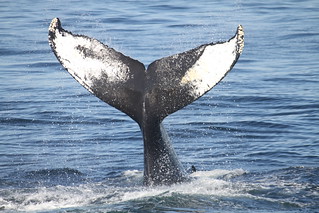
not end the continuous “whale wars.” Whales are extremely vital to everyone; they
help balance the marine food chain, offset carbon emissions, provide a source
of income in whale-watching tourism, and have led to a variety of discoveries
and advancements in technology and knowledge about marine ecosystems. Because
current whaling is not sustainable and a market trading system would be equally
ineffective, the only logical solution is to prohibit all
whaling. I believe that only this solution would prevent violence on the sea
and damage to the whale population, two issues that are becoming increasingly
dangerous and difficult to manage.
Works Cited
1. Costello,
Christopher, Steven Gaines, and Leah R Gerber. “Conservation Science: A Market
Approach to Saving the Whales.” Nature. 11 Jan. 2012 <http://www.nature.com/nature/journal/v481/n7380/full/481139a.html#/affil-a>.

No comments:
Post a Comment